Why 'Price Per Gigabyte' Is a Lie: 5 Realities of AI Data Collection
Introduction: The Engine Room and the Bottleneck
Data collection is the engine room of modern enterprise AI. It's the critical, continuous stream of high-quality information required for both training groundbreaking models and powering real-time inference. But for most teams building AI products, it's also the single most critical and often hidden challenge—the bottleneck that slows development, inflates budgets, and introduces unacceptable risk.
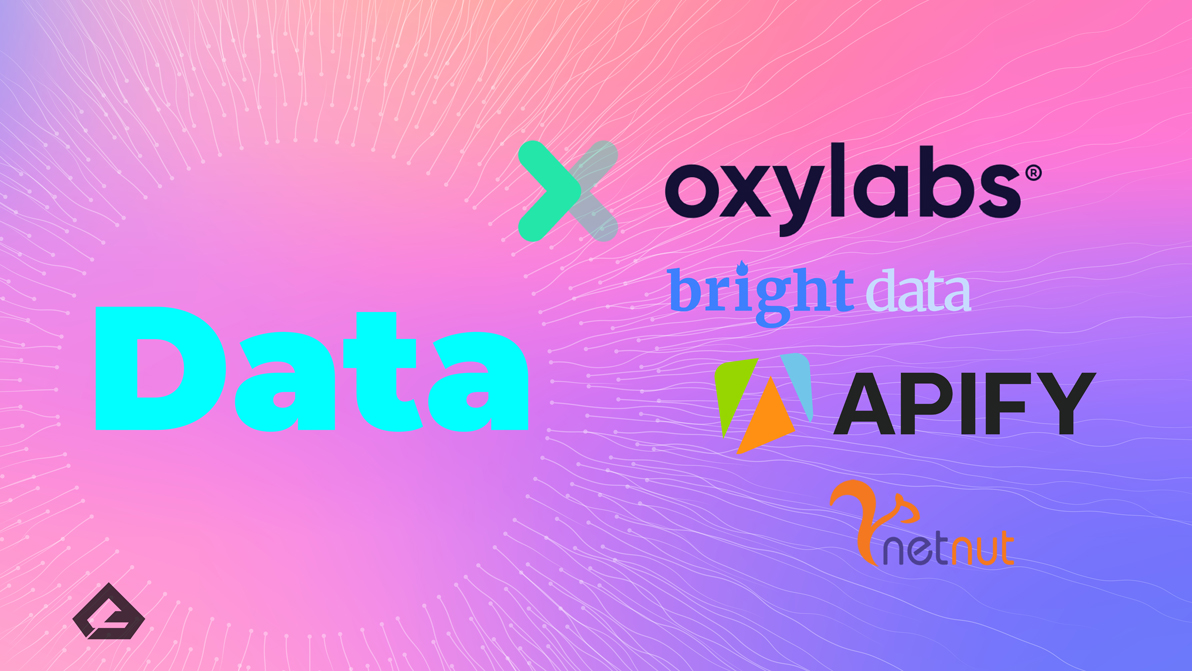
While the market for web data collection has four heavyweights—NetNut, Bright Data, Oxylabs, and Apify—choosing between them is far more complex than comparing feature lists. These services are not interchangeable, and picking the wrong one based on a misleading sticker price can have ruinous financial and strategic consequences.
This article distills the most surprising and impactful takeaways from extensive enterprise research. Our goal is to illuminate the hidden complexities of AI data collection, helping you avoid the common, costly mistakes that derail promising AI projects before they even get off the ground.
1. The "Big Four" Aren't Just Competitors—They're Playing Different Games
The first and most critical realization is that the four main vendors are not simply competitors in the same race; they are built for fundamentally different purposes and serve distinct needs.
NetNut: The Drag Racer. With a network of over 52 million IPs, NetNut is focused on raw infrastructure and speed. Its key differentiator is its direct partnerships with Internet Service Providers (ISPs), which bypass middle layers to provide what the research identifies as the "fastest residential proxies on the market." This makes NetNut the ideal choice for teams that need to collect massive volumes of data at maximum velocity and are willing to build their own scraping logic on top of a high-performance foundation.
Bright Data: The Comprehensive Enterprise-Grade Platform. Bright Data positions itself as an end-to-end solution with a heavy emphasis on risk mitigation. Boasting the industry's largest network of over 150 million total IPs (with a 72 million residential core), its core value proposition is compliance. Its SOC2 Type II certification is non-negotiable for large companies where legal and finance teams need documented proof of security and ethical data sourcing.
Oxylabs: The Premium Reliability Engine. Backed by a massive network of over 177 million IPs (102 million+ residential), Oxylabs is characterized by its focus on enterprise-grade reliability, backed by a powerful "100% data delivery guarantee." For operations where failure is not an option, this assurance is paramount. Oxylabs is increasingly using AI tools like OxyCopilot to automate the complexity of scraper development and maintenance, arguing that automation is the only way to beat modern anti-bot technology.
Apify: The Developer-First Automation Platform. Apify operates on a completely different model. It is a developer-centric automation platform built around a community marketplace of over 5,000 pre-built "Actors"—essentially an "app store for data extraction." Its serverless, pay-per-use architecture makes it the ultimate choice for teams that value flexibility, customization, and low-cost experimentation.
Understanding these identities is the first step: are you buying raw infrastructure (NetNut), a compliance shield (Bright Data), a reliability guarantee (Oxylabs), or a flexible toolkit (Apify)? Answering this clarifies your vendor shortlist immediately.
2. The Sticker Price is a Trap: Why Price-per-GB is the Wrong Metric
One of the most direct findings from the source material is a stark warning for anyone focused on initial pricing:
"the price per gigabyte is well, it's a lie. ... It's misleading at best."
The sticker price represents only 60-70% of the true cost of data collection. To understand the real investment, you must analyze the Total Cost of Ownership (TCO), which includes significant hidden expenses that make up the other 30-40%.
Internal Engineering Time: The research suggests you must budget "20-30% of the data cost itself" just for your internal engineering team to spend on data validation, cleaning, and integration. What you pay the vendor is just the beginning; what you pay your own team to fight with and fix the data is a massive, often ignored, expense.
Opportunity Cost of Delays: A cheaper service with a lower success rate can introduce pipeline stalls that are financially ruinous. Imagine your AI product launch is delayed by three weeks because your data vendor failed. The lost revenue and market share from that delay will dwarf any savings. The source guides show this clearly: in a small AI startup scenario, choosing Apify for a defined task could cost around $2,300, while a more comprehensive solution from Bright Data for the same data volume might total $7,000. The higher price reflects the cost of tooling and risk mitigation—a trade-off that must be evaluated strategically, not just on sticker price. This is why the research insists that data collection should be "30-40% of the total AI infrastructure budget." Underfunding it guarantees delays.
3. A 15% Difference in Success Rate Can Make or Break Your Project
Many teams fall into the trap of thinking they can simply retry failed data requests. This is a critical error in judgment. When a request fails, you pay for the failed attempt, pay again for the retry, and absorb the engineering cost of managing the entire complex process—all while your project timeline slips.
The impact of reliability is not marginal; it's exponential. As the evaluation guide quantifies:
A 95% success rate vs 80% means 15% fewer failed requests and retries.
When multiplied across the millions of pages required for AI model training, that 15% difference translates into a massive reduction in wasted bandwidth, compute, and engineering hours. The top performers on this metric are Oxylabs (95%+), leveraging excellent ML-driven systems; Bright Data (90-95%), with its very strong AI-powered unblocker; and NetNut (85-95%), which derives its stability from direct ISP connections.
4. Your Data's Passport Matters: Why Global Coverage is Non-Negotiable
A common but dangerous misconception is that scraping the English-speaking web is sufficient for training a robust AI model. For any company building a global product, this approach is a direct path to failure. The need for comprehensive geographic coverage across 195+ countries is non-negotiable for three critical reasons.
First, to understand regional e-commerce and local trends. Second, to capture language diversity and nuanced dialects for better NLP performance. Third, and most importantly, is bias reduction.
An AI model trained exclusively on data from the US and Western Europe will become "culturally myopic." It will develop significant regional biases on everything from product sentiment to ethical frameworks. This creates a severe risk of launching a global model that performs poorly or "even offensively in certain markets." This isn't theoretical; the source reports directly link global coverage to superior performance in regional e-commerce training and the creation of more nuanced language models. Ensuring your data provider offers true global coverage is a crucial strategic and ethical consideration.
5. The Only Metric That Matters: Cost Per Successful Page
If the cost per raw gigabyte is a lie, what is the truth? The research offers a final, powerful takeaway: stop tracking raw data costs and adopt the one metric that reveals the true financial and operational efficiency of your pipeline.
The only metric that truly matters is the cost per successful page.
This figure is calculated by dividing your total expense—including the base subscription, wasted bandwidth from failed requests, and the cost of your internal engineering time—by only the number of pages that were successfully extracted and used.
This single metric cuts through vendor marketing and reveals the actual price you are paying for usable information. The analysis provides a clear benchmark for elite performance: teams should aim for a cost per successful page of less than $0.01. Achieving this target is the real measure of an efficient, scalable, and cost-effective data pipeline.
Conclusion: A Strategic Choice, Not a Technical One
The evidence is clear: data provider selection is not a procurement task to be delegated, but a core strategic decision with consequences that ripple through the entire AI development lifecycle. The right choice accelerates time-to-market and reduces risk, while the wrong one guarantees budget overruns and project delays.
As you weigh these options, consider one final, thought-provoking question raised by the research: "By choosing a comprehensive managed service, you mitigate risk today, but are you sacrificing the long-term agility and flexibility your own engineering team might need tomorrow? That trade-off between vendor lock-in and platform control is a strategic factor not easily captured in any price sheet."
This analysis synthesizes insights from extensive enterprise research on AI data collection infrastructure. Specific pricing and performance metrics are based on available public information and industry analysis.